
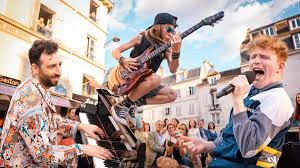

What followed was pure chaos and magic. Thirty musicians, scattered through the square as if planted among the crowd, suddenly joined in. A violin section emerged from behind café tables, brass players swung their horns toward the sky, and drummers pounded out the rhythm on improvised percussion. The square transformed into a stage, and the city into an audience swept up in one of the most audacious Queen tributes ever attempted.

The beauty of the moment wasn’t just in the music—it was in the reaction. Tourists abandoned their photos to sing along. Waiters dropped trays to clap in rhythm. Strangers who minutes earlier had never exchanged a glance were suddenly harmonizing with arms around each other’s shoulders. Paris became less of a city and more of a chorus, a reminder that music at its best doesn’t just entertain—it unites.

By the time the operatic section hit, the square was vibrating. Voices layered in a dramatic call-and-response, horns screamed over pounding drums, and the singer on the carriage threw his head back as though channeling Freddie Mercury himself. The finale—an explosion of sound and light—drew cheers so loud they echoed off the centuries-old stone walls. It was spectacle, street theater, and rock opera rolled into one unforgettable performance.
In the end, the flash mob was more than just a viral stunt—it was a reminder of why “Bohemian Rhapsody” endures. Decades after its release, it still has the power to stop a city in its tracks, to make strangers into family, and to prove that Freddie Mercury’s magic belongs not just to the past, but to every moment it is sung again.