
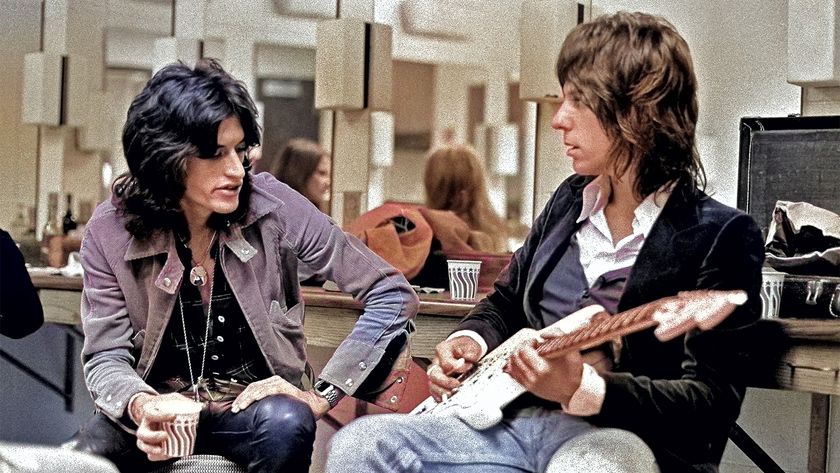

(Image credit: Getty Images)
Over a 56-year recording career, Paul Rodgers has collected guitar players like a connoisseur collecting fine wines. They’re pulled in by the soulful power of his voice, and he embraces what the combination, and combustion, of that with their playing can do to a song.
Consider the company English-born Rodgers — a solid rhythm guitarist himself, as well as a pianist — has kept, starting with the late Paul Kossoff in Free between 1969 and 1973, the band that put both men on the rock and roll map.
After that he joined forces with Mott the Hoople’s Mick Ralphs in the recently minted Rock and Roll Hall of Fame group Bad Company, for six albums defined by brawny, muscular but still sophisticated hard rock that had few peers for success during the ’70s. (The new Can’t Get Enough: A Tribute to Bad Company demonstrates the group’s continuing influence, with Rodgers and drummer Simon Kirke joining on tracks like “Shooting Star” and “Feel Like Makin’ Love” with Halestorm, Blackberry Smoke and Def Leppard’s Joe Elliott and Phil Collen.)
Then for his next trick? No less than Jimmy Page in the short-lived band the Firm, delivering a pair of powerhouse albums and Billboard Mainstream Rock chart toppers such as “Radioactive” and “All the King’s Horses.”
Rodgers went on to join forces with drummer Kenney Jones in the Law, then spent five years alongside Brian May in Queen + Paul Rodgers, another supergroup collaboration that brought May and drummer Roger Taylor back on the road and also yielded two live albums and 2008’s The Cosmos Rocks, the first Queen-related studio album since 1995’s Made In Heaven.
Rodgers maintained his impressive six-string relationships outside of his band affiliations, too, and through his seven solo albums — Jeff Beck, Joe Bonamassa, Steve Cropper and Slash among them.
“I don’t really know the secret of how guitarists create their own unique sounds,” he tells us, “but I know a good guitar sound when I hear it.”