
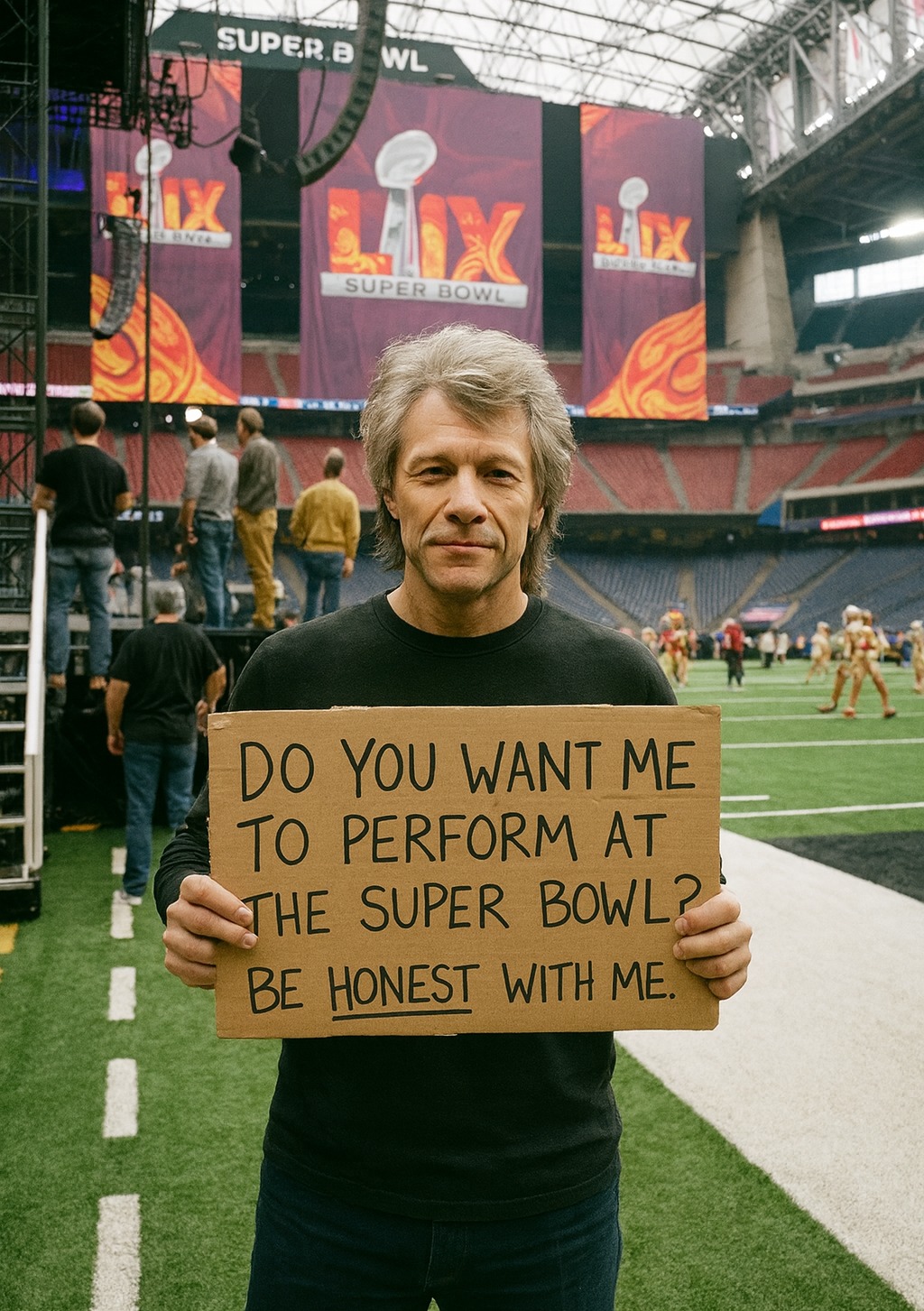
In the weeks leading up to Super Bowl LX, one name has kept surfacing with the stubborn persistence of a chorus you can’t shake: Jon Bon Jovi. The claim moving through fan pages, group chats, and late-night sports radio is simple and explosive—Bon Jovi, headlining the halftime show on February 8, 2026, at Levi’s Stadium in Santa Clara. As with most Super Bowl speculation, the details arrive packaged as “sources close to the league” and “insiders who can’t talk yet,” the kind of language that thrives in the gap between anticipation and confirmation.
Whether the booking is real or still rumor, the reaction has revealed something bigger than a lineup. People aren’t just arguing about a performer. They’re arguing about what halftime is supposed to be. In an era of lasers, surprise guests, and spectacle engineered for TikTok, the fantasy of Jon Bon Jovi is the fantasy of anthems—three minutes of unity, sung loudly enough to drown out the noise of everything else.
WHY BON JOVI FEELS LIKE A “SUPER BOWL” ARTIST
If the Super Bowl is America’s loudest living room, Bon Jovi is one of the few artists whose catalog naturally fits the scale. His songs aren’t just hits; they’re communal muscle memory. They live in wedding receptions, sports arenas, dive bars, road trips, and small-town jukeboxes. The choruses work like public property—people don’t “listen” so much as join in.
That’s why the rumor hits a nerve. A Bon Jovi halftime show wouldn’t need an elaborate narrative to land. The narrative is already built into the songs: resilience, stubborn hope, blue-collar romance, the belief that you can get knocked down and still stand back up with your fists in the air. Whether you see it as timeless or overfamiliar, it’s undeniably built for mass participation.
And in the Super Bowl ecosystem, participation is the whole game. You don’t just want viewers to watch. You want them to sing.
THE “NO CIRCUS” VERSION OF HALFTIME

Part of what makes the Bon Jovi scenario so appealing to fans is the imagined restraint. The fantasy isn’t a futuristic stage with twenty cameos. It’s something simpler: Jon stepping into the light, guitar strapped on, band locked in behind him, and the first lyric landing like a match.
“Shot through the heart…” is the kind of opening line that would instantly turn a stadium into a choir. It doesn’t require context. It doesn’t require a new arrangement. It requires only volume and a crowd willing to become part of the performance.
That idea—less spectacle, more song—is the opposite of the modern halftime arms race. It’s also, for many viewers, exactly what feels missing. Fans aren’t rejecting production values; they’re craving emotional clarity. A show where the music is the event, not the effects.
THE SETLIST EVERYONE IS PREDICTING
This is where the rumor turns into sport: the setlist predictions. If Bon Jovi were to headline, there are obvious anchors that practically write themselves. “Livin’ on a Prayer” is a cultural monument. “Wanted Dead or Alive” carries cinematic Americana. “It’s My Life” is built for a televised crowd chant. “You Give Love a Bad Name” is a guaranteed ignition switch.
Then there are the ballads—“Bed of Roses,” “Always”—songs that could shift the tone for thirty seconds and remind people this isn’t only party music, it’s memory music. A halftime show needs peaks and valleys. Bon Jovi’s catalog can provide both without leaving the mainstream lane.
But what fans keep whispering about isn’t the obvious hits. It’s the idea of a deep cut—a “never-again” song, a track Jon supposedly avoids, tied to a personal story that hasn’t been publicly excavated. Whether that’s true or not, it speaks to something real: audiences want one moment that feels like a secret shared with millions.
The Super Bowl thrives on that kind of engineered intimacy.
WHAT IT WOULD MEAN FOR JON BON JOVI—AND FOR HIS LEGACY
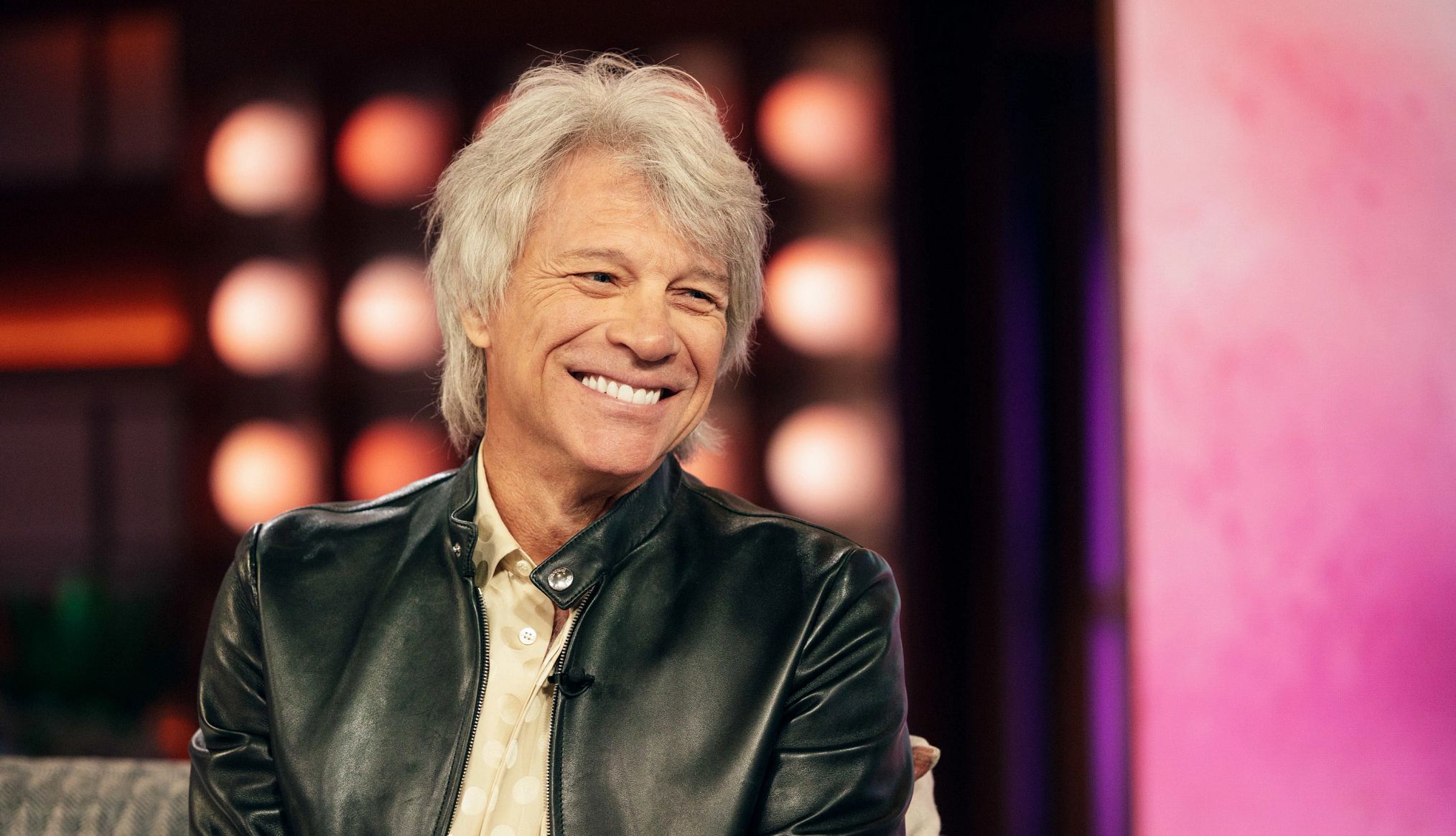
There’s also a personal narrative hovering around this rumor: the idea of return, endurance, and legacy. Bon Jovi is not a new act looking for a breakthrough. He’s a veteran with decades of cultural footprint behind him. That changes the stakes. A halftime show for him would not be “a big opportunity.” It would be a public summation—a national stage framing what his music has meant across generations.
For some fans, that’s exactly why they want it. The Super Bowl isn’t just a game; it’s a collective snapshot of the country. Putting Bon Jovi there is a way of saying: this is what we still sing when we want to feel like ourselves.
And for skeptics, the fear is the mirror image: that a Bon Jovi halftime show could feel like a nostalgia play. But nostalgia is only cheap when it’s hollow. Bon Jovi’s songs, for better or worse, are not hollow to millions of people. They are tied to real life—first loves, first jobs, last goodbyes, long drives, broken years, repaired years.
That’s why the debate is so heated. People aren’t arguing about a performer. They’re arguing about what kind of emotional story America wants to tell on its biggest night.
WHY THIS RUMOR SPREADS SO FAST
Super Bowl halftime rumors spread quickly because they offer a low-stakes way to project values. When you say “it should be Bon Jovi,” you’re saying you want the halftime show to feel like a singalong. When you say “it should be someone else,” you might want innovation, surprise, edge, or global pop relevance.
Bon Jovi sits in a unique middle: rock credibility, pop familiarity, cross-generational recognition. That makes him an ideal rumor candidate because almost everyone has an opinion—fans, critics, casual viewers, people who only know the chorus and still feel it in their bones.
And if the rumor turns out to be wrong, the conversation still served its purpose: it revealed what people are craving.
IF IT HAPPENS, HERE’S WHAT THE MOMENT COULD LOOK LIKE
Imagine the lights dropping over Levi’s Stadium. The noise folding inward. A simple riff cutting through. Jon stepping forward—no speech, no setup—just a line that millions can finish before he does.
For a few minutes, the Super Bowl wouldn’t belong to teams or commercials. It would belong to the crowd.
And if he closes with “Who Says You Can’t Go Home,” it won’t land as a clever title. It will land as a statement—an idea that on the biggest night of the year, with the whole country watching, the simplest thing can still be the most powerful:
A chorus. A shared breath. A stadium singing the same words at once.