
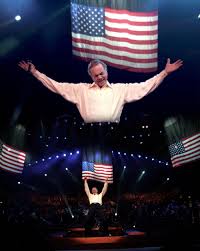

When Neil Diamond steps to the microphone and sings “America,” something remarkable happens — the song stops being just music. It becomes a mirror, a prayer, and a promise all at once. The opening chords swell like the first light of dawn, and suddenly you’re not just listening — you’re remembering. Remembering your grandparents stepping off a ship with trembling hands. Remembering your parents working late nights in kitchens and factories. Remembering the moment you yourself felt hope burn brighter than fear.
Neil wrote “America” for the 1980 film The Jazz Singer, but the song quickly escaped the screen and took on a life of its own. It wasn’t simply about one story — it was about millions. With every line, he stitched together the fabric of a nation built not by power alone, but by the courage of those who crossed oceans and borders in search of something better.
💬 “Everywhere around the world, they’re coming to America…”
That lyric is more than a refrain — it’s a heartbeat. It thunders in stadiums, in parades, in classrooms, in quiet homes where families still speak in accents thick with memory. Neil’s voice carries it like a torch, reminding us that America isn’t a geography, it’s an idea — one carried in suitcases, whispered in prayers, etched in the lines of calloused hands.
What makes the song so enduring is its intimacy. Patriotic songs often point to flags and fireworks, but “America” points inward — to longing, to sacrifice, to resilience. When Diamond belts the chorus, it feels like he’s standing shoulder to shoulder with every traveler who ever dared to believe that the next horizon could be home. That’s why the song doesn’t just inspire — it heals. It reminds us that pride and pain can exist together, that the dream is both fragile and eternal.
Released at the dawn of a new decade, “America” became an anthem not only for immigrants but for anyone who had ever felt displaced or unseen. It played during rallies, at graduations, in stadiums where strangers stood side by side with tears in their eyes. After 9/11, it found new life as a unifying cry in a grieving nation. And even now, decades later, the song resurfaces whenever the country asks itself who it is, and what it stands for.
But at its core, “America” is not about politics. It’s about people. The mothers who carried their children across borders. The fathers who worked three jobs to give their kids a shot. The young dreamers who arrived with nothing but faith. Neil Diamond gave them a song — and in doing so, he gave them dignity.
When he performed it live, you could see it in his eyes: this was not entertainment. This was testimony. His hand would rise to the sky, his voice would shake with urgency, and the crowd — tens of thousands strong — would rise as one. Some waved flags, some wept openly, some held the hand of a loved one tighter. In that moment, all differences seemed to dissolve.
That is the power of “America.” It doesn’t belong to one group, one generation, or one history. It belongs to anyone who has ever dreamed of freedom, of safety, of belonging. It belongs to those who came on ships a century ago, and to those still crossing borders today. It belongs to the world.
So when Neil Diamond sings it, it’s not just nostalgia. It’s renewal. It’s the reminder that the story of America is still being written, in every language, in every corner, with every voice brave enough to call this place home.
And as long as that song plays, as long as his voice rises with conviction, there will always be hope — that no matter where you start, there’s a place where you can arrive, stand tall, and finally say: I belong.