

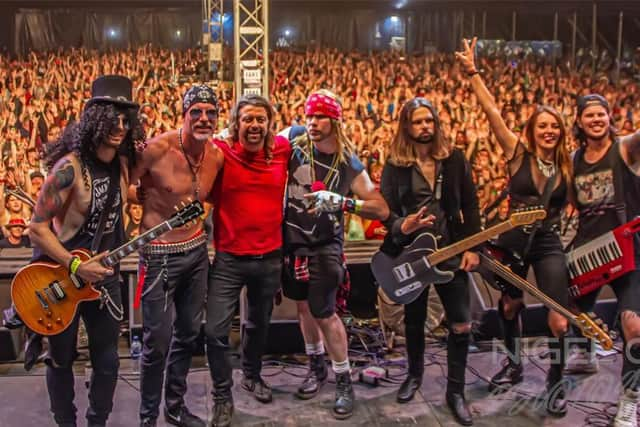
One of his most striking moments came when he joined forces with Guns 2 Roses, a well-established Guns N’ Roses tribute band known for their faithful recreations of the legendary group’s sound and stage presence. Together, they chose an unexpected song: Slither, originally performed by Velvet Revolver. Released in 2004, Slither became Velvet Revolver’s breakthrough hit, winning a Grammy Award for Best Hard Rock Performance. Its grinding riffs and Scott Weiland’s snarling vocals made it a definitive track of the 2000s rock revival.

In the collaboration, Guns 2 Roses brought the grit and weight of experienced rock musicians, while Pearson added an edge of youthful unpredictability. What stood out most was how well Pearson’s vocals fit the song’s demanding style. Rather than being overshadowed, he held his own, delivering each line with conviction. His ability to balance control with aggression is rare at his age, and it made for a performance that was both authentic and refreshing. The crowd’s reaction reflected that surprise: instead of seeing a young singer as a novelty, they recognized genuine rock potential.
Pearson’s path, however, isn’t defined by a single collaboration. Just weeks later, he was back in the spotlight during a large-scale flashmob performance of Queen’s Bohemian Rhapsody in Paris. Originally released in 1975, Queen’s classic remains one of the most ambitious and complex songs in rock history. Its operatic sections, sudden shifts in style, and dramatic guitar solos make it a daunting challenge for even seasoned musicians.

Organized by pianist Julien Cohen, the flashmob brought together more than 30 performers, with singers filling the windows of surrounding buildings and musicians scattered across the busy Parisian street. While Cohen anchored the performance on piano, it was Pearson’s guitar work that became a highlight. Taking on Brian May’s iconic solos, Pearson delivered them with precision and confidence, proving that his musicianship extends well beyond vocals. The crowd, at first expecting a standard busker setup, quickly realized they were witnessing something on a much larger scale.
What connects both performances — Slither with Guns 2 Roses and Bohemian Rhapsody in Paris — is Pearson’s ability to adapt to very different rock contexts. Slither is raw, aggressive, and modern; Bohemian Rhapsody is theatrical, layered, and iconic. To shine in both requires versatility and a deep understanding of what makes each song powerful. Pearson seems to grasp that instinctively, approaching the music with respect but also with the boldness of someone unafraid to put his own stamp on it.
For Pearson, these collaborations are more than impressive moments; they’re milestones in a young career that is steadily taking shape. By stepping into the worlds of both classic and modern rock, he’s showing audiences that the future of the genre may not just rest in established stars, but in emerging voices who bring new energy to the stage.