
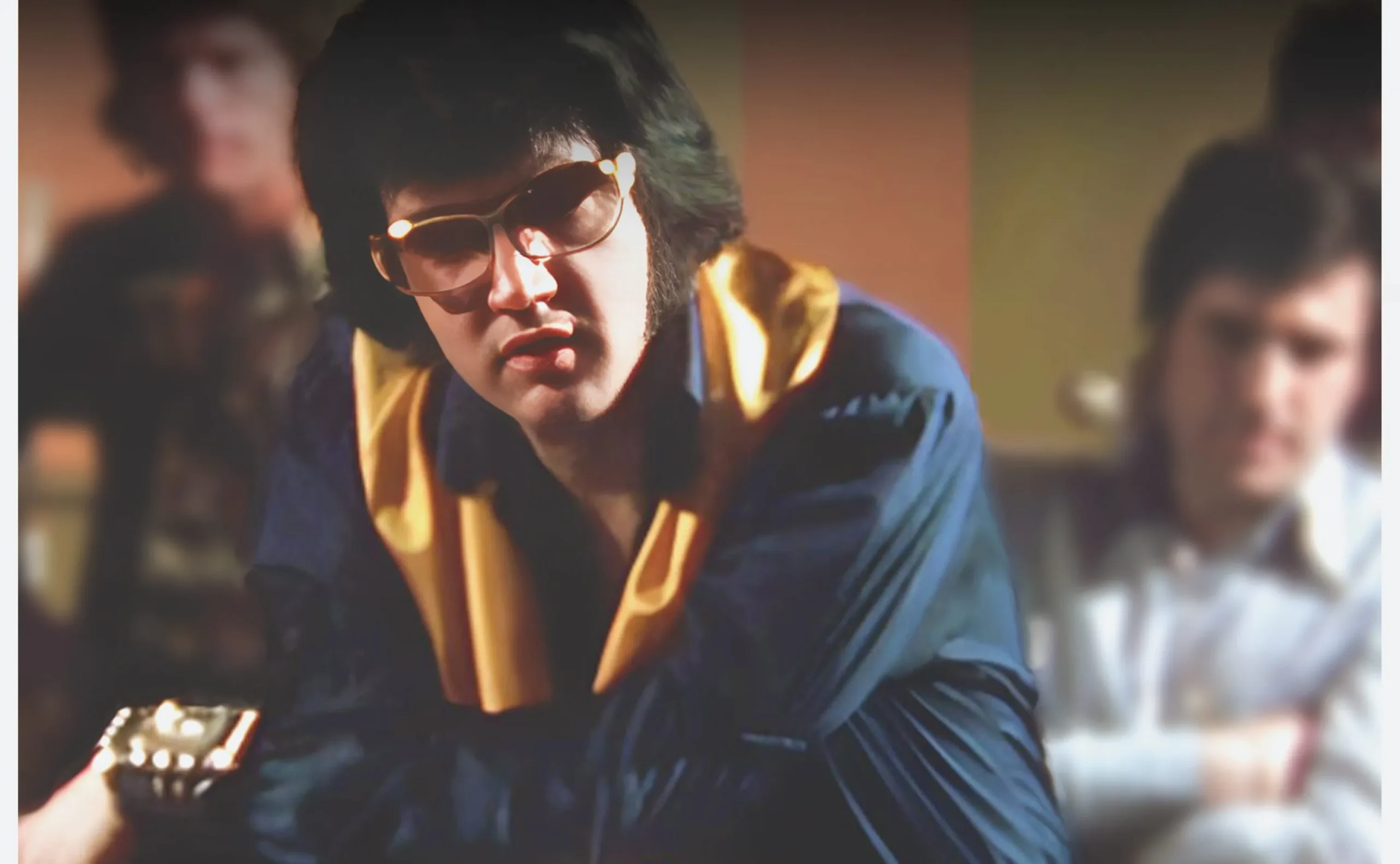

A Forgotten Story That Reveals the King’s True Heart**
It was the kind of Southern summer day that melts into memory — blazing sun, shimmering asphalt, and the long, lonely stretch of Highway 51, somewhere between Memphis and Mississippi. Elvis Presley was behind the wheel of his Stutz Bearcat, heading back from his Circle G Ranch with his bodyguard Sam Thompson, Sam’s wife Louise, and Linda Thompson riding along.
That’s when they saw him.
A little boy — ten, maybe eleven — sitting alone at a roadside watermelon stand, dust settling around him like it had been part of his skin all summer. No cars. No customers. Just a kid waiting in the heat with more patience than most grown men.
Elvis slowed.
Then he stopped.
For the boy, this was no ordinary customer. Sam Thompson would later recall that the kid recognized Elvis immediately — how could he not? This was the most famous face in America, stepping out of a sports car in the middle of nowhere.
But the boy didn’t budge.
No gasp.
No smile.
No “Oh my gosh… Elvis!”
He didn’t run up to the car.
He didn’t try to impress the King.
He made Elvis come to him.
And Elvis loved that.
The King of Rock and Roll walked across the dusty shoulder like any other man running an errand.
“How much are the watermelons?” he asked.
A price was named. Fair. Firm. Final.
Elvis did what Elvis did best — charmed, joked, nudged, tried to negotiate. But the kid was a stone wall in the Mississippi sun.
Not a penny off.
Not for Elvis Presley.
Not for anyone.
Sam Thompson watched it unfold: the biggest star in the world, standing on a dusty highway, haggling with a ten-year-old who refused to be starstruck.
Finally, seeing he wasn’t going to change the boy’s mind, Elvis turned to his group and said:
“We’ll take the whole stand.”
And that was the moment the boy’s tough façade cracked.
They loaded every watermelon — dozens — into the car. Elvis didn’t need them. He didn’t have a practical use for half of them. But that wasn’t the point.
The point was respect.
In that stubborn little businessman, Elvis saw something he admired:
dignity, courage, honesty, steady hands in a dusty summer heat.
This wasn’t a superstar expecting special treatment. Elvis didn’t hint at his fame, didn’t push his weight around, didn’t expect a discount for being Elvis Presley. He treated the kid like an equal.
And the kid treated him like just another man trying to buy watermelons.
Years later, Sam Thompson would retell the story with awe — how a tiny moment on a forgotten highway had revealed the part of Elvis the world rarely got to see:
the man who noticed people.
The man who stopped.
The man who listened.
Not the stage icon.
Not the tabloid character.
But the human being who respected a boy selling watermelons enough to honor his price — and reward his backbone.
That kid probably told the story for the rest of his life:
“Elvis Presley stopped at my watermelon stand.
I didn’t give him a discount.
He bought everything I had.”
Some celebrities lose themselves in fame.
Elvis didn’t. Not on that day.
Not on that dusty stretch of Highway 51.
He was the most famous man in America.
But he still stopped for a kid with a watermelon stand — and treated him like an equal.
That’s not just generosity.
That’s not just kindness.
That’s grace.