
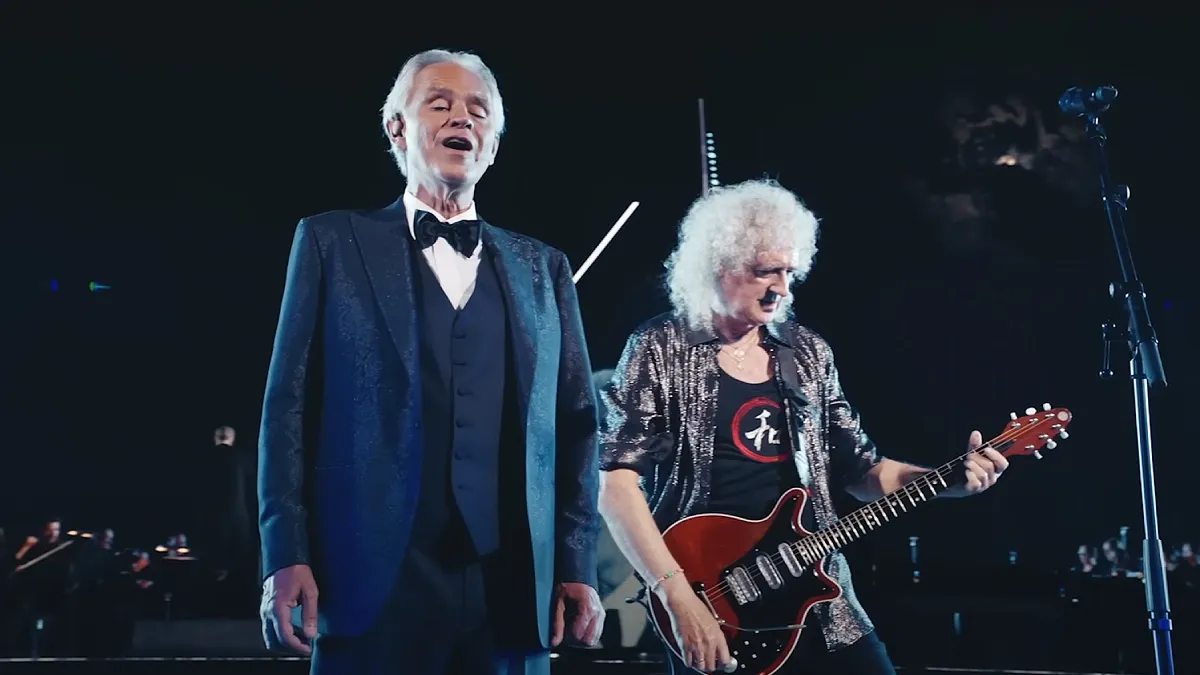

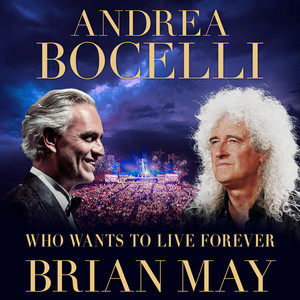
In a moment that bridges rock legend and operatic grandeur, Brian May and Andrea Bocelli joined forces to deliver a spine‑tingling rendition of the Queen classic “Who Wants to Live Forever”—and the result is nothing short of magical.
🎤 The Setting
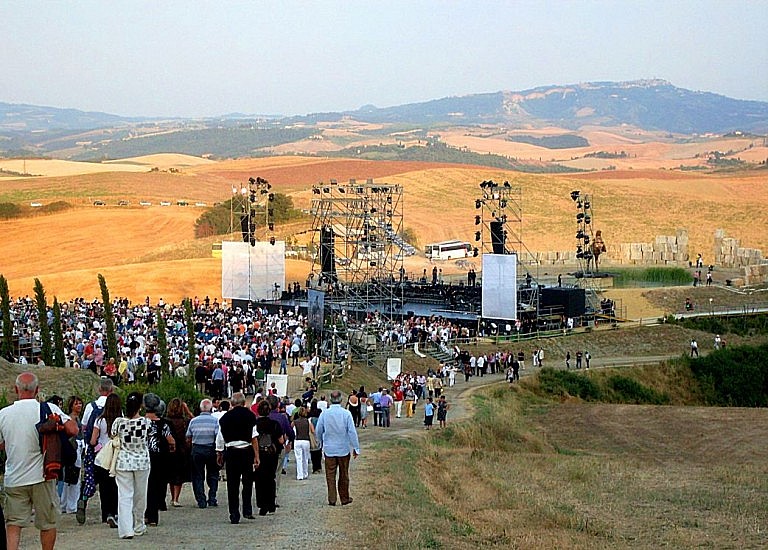
The performance took place during Bocelli’s 30‑year career celebration, held at the open‑air amphitheatre Teatro del Silenzio in Lajatico, Tuscany.
Against the backdrop of rolling Tuscan hills and evening light, May picked up his guitar and took lead vocals—an unusual but deeply fitting choice. Soon, Bocelli’s powerful tenor joined him, the orchestral backing swelling behind them.
🎶 Why the Song Matters
“Who Wants to Live Forever” was written by Brian May for Queen’s A Kind of Magic album (1986), and originally featured in the film Highlander.
It’s a piece built on themes of mortality, love, longing—and a sweeping orchestral rock arrangement that lends itself beautifully to both power rock and classical voice. The meeting of May’s guitar and vocals with Bocelli’s operatic strength makes perfect sense in this context.
✨ The Performance & Its Magic
-
May opens tenderly, guitar in hand, his voice steady and clear, leading into the chorus: “Who wants to live forever?”
-
Then Bocelli enters—his voice soaring above the orchestral swell, carrying the emotion of the lyric with a depth that sends chills through the audience.
-
The juxtaposition is striking: rock‑guitar legend meets the classical tenor in an outdoor amphitheatre bathed in Italian light, bringing two worlds together seamlessly.
-
Fans watching the released video are visibly moved, many calling it “a fitting rendition of a deeply moving song” and suggesting that the late Freddie Mercury would have been proud.
🎥 What Fans Are Saying
“A fitting rendition of a deeply moving song.”
“Freddie would love it.”
And indeed, what’s remarkable is how the performance retains the sonic identity of Queen while elevating it into a new dimension through Bocelli’s voice and the orchestral setting.
🌟 Why This Lies So Deeply
-
Cross‑genre fusion done right. Rock and opera don’t often walk hand‑in‑hand, but here, they do—elevating rather than diluting either side.
-
Emotional resonance. The song itself grapples with the desire for permanence—something wholly ironic for the title—and delivers it with both delicacy and power.
-
Legacy connection. May isn’t just performing: he wrote the song. Bocelli brings his global stature in classical/ crossover. Together, they pay tribute to Queen’s legacy while creating something new.
-
Setting amplifies impact. The Toscany scene, the open‑air theatre, the night sky—it all adds an element of wonder, not just a performance but a moment.
🔊 Where to Watch/Listen
You can find the video of this duet on Bocelli’s official YouTube channel, and the audio is available via streaming platforms through the release tied to “Andrea Bocelli 30: The Celebration”.
💭 A Final Thought
This isn’t just another cover. It’s a collision of worlds—and one where both emerge elevated. Brian May and Andrea Bocelli didn’t simply perform together: they met at the crossroads of rock and classical, of legacy and reinterpretation, and reminded us that great art transcends genre.
If you haven’t seen it yet, I’d urge you: put on headphones, press play, and let the music carry you. Because this one? It’s unforgettable.
Here’s the video of Andrea Bocelli and Brian May performing Who Wants to Live Forever live at Teatro del Silenzio in Tuscany:
🎬 Video & Behind‑the‑Scenes
-
The video was uploaded by Andrea Bocelli’s official YouTube channel and has already racked up over 5 million views.
-
The performance took place in July 2024, at the open‑air amphitheatre Teatro del Silenzio (capacity ~10,000) in Lajatico, Tuscany — a venue partly funded by Bocelli himself.
-
This collaboration is part of “Andrea Bocelli 30: The Celebration,” his three‑day career milestone concert event.
📸 Backstage & Photos

Here are some behind‑the‑scenes and live photos to capture the moment:
-
The amphitheatre setting under the Tuscan sky adds a dramatic, almost cinematic backdrop.
-
Brian May and Andrea Bocelli sharing the stage: one icon of rock‑guitar legacy, the other a globe‑famed tenor, both meeting in that song.
-
The crowd, lighting, and setting create more than a concert — it’s an event.
🧑🎤 What Artists Said
-
Bocelli spoke of May with genuine admiration: he described him as “a man of rare intelligence and culture… one of the best guitarists of our time, a songwriter who has penned numerous timeless hits”.
-
May still plays a guitar he built with his father when he was seventeen, and told Bocelli that “just like you and your voice, Andrea, which is a part of you, my guitar is my voice.”
📸 Photo Gallery


-
You’ll see the live stage moment: May on guitar, Bocelli in his formal stagewear, the orchestra behind them.
-
The open‑air amphitheatre setting at Teatro del Silenzio in Tuscany, Italy, glowing under evening light.
-
Audience and surrounding scenery — giving a sense of atmosphere and scale.
-
Close‑ups of the two artists during their moment on stage.
💬 Fan Reactions & Social Buzz
Here are some representative reactions that surfaced after the performance:
-
On a Facebook post of the duo:
“So sweet. What a dynamic duo!”
“This made me smile so wide, my face hurts!! I love this soooooo much!! He sounded awesome!!” -
On Instagram:
A video post from Brian May’s account of the rehearsal with Bocelli, captioned “A new adventure !!! A new challenge ! With my dear friend Andrea Bocelli !” – showing the warm behind‑the‑scenes rapport. -
Media coverage summarised fan sentiment:
The article by uDiscover Music noted the track’s release and said the tenor and guitarist “performed the song … at Tuscany’s ‘Teatro del Silenzio’ … the video shows the two artists commanding a crowd of 10,000”.
These reactions reflect not just admiration but a sense of delight: fans are thrilled by the unexpected pairing, moved by the performance, and impressed by its emotional weight.
✅ Highlights Summary
-
The visuals show how beautifully staged the event was—rock meets classical, Tuscany meets global audience.
-
The social responses confirm the emotional impact: it wasn’t just technically impressive, it felt meaningful.
-
The combination of live footage + fan reactions gives a full sense of the moment’s resonance.