
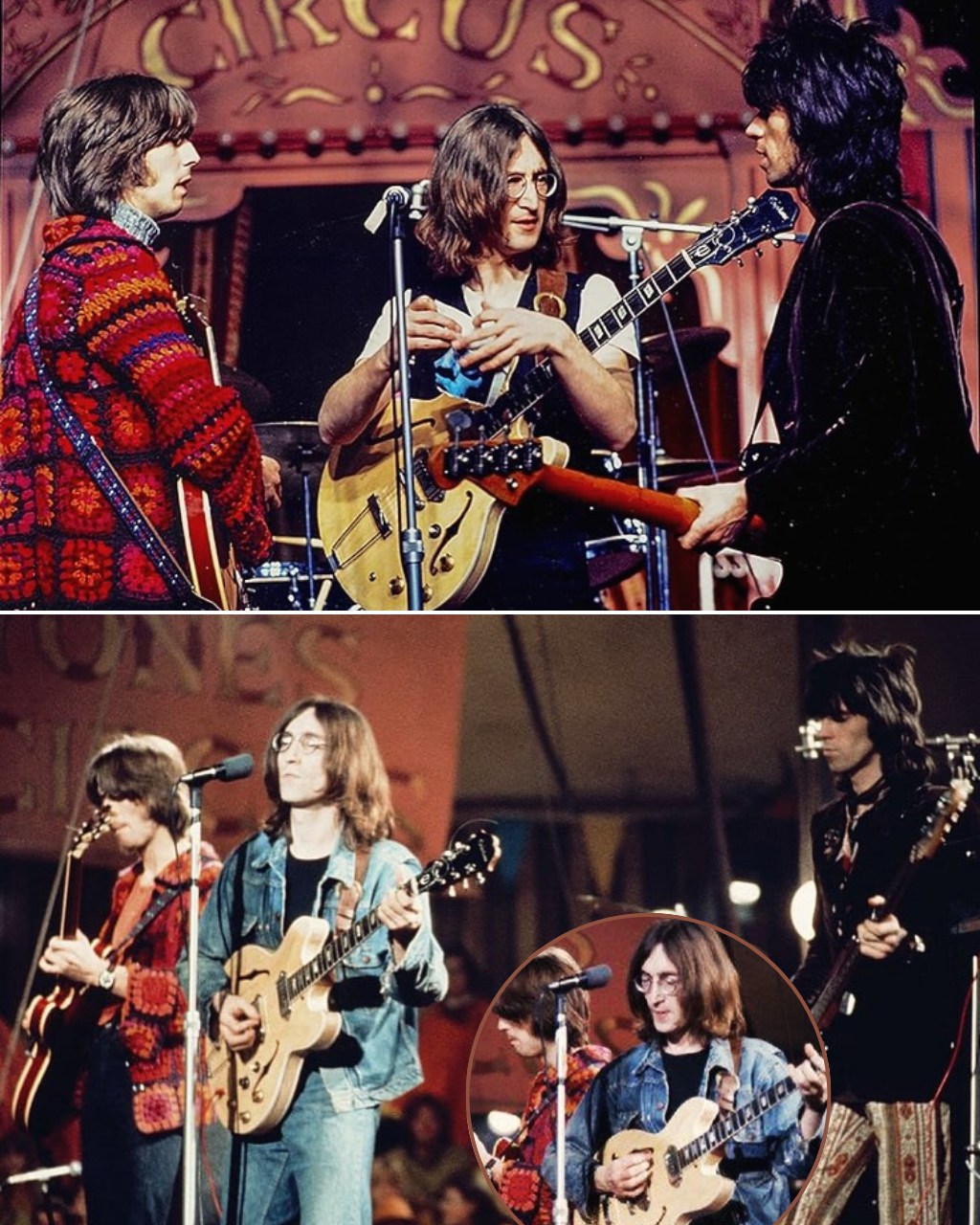

The Night John Lennon Stepped on Stage Without The Beatles — And Why December 1968 Quietly Changed Everything
By December 1968, the world still believed The Beatles were intact.
Yes, there were rumors. Yes, the White Album had exposed fractures — competing visions, separate rooms, songs that sounded less like a band and more like four parallel worlds. But officially, nothing had ended. The name still stood. The myth still held.
And yet, on one cold London night, something happened that almost no one was supposed to notice.
John Lennon walked onto a stage without The Beatles.
Not as a protest.
Not as an announcement.
Not even as “John Lennon.”

A Supergroup That Wasn’t Meant to Mean Anything — Until It Did
The setting was The Rolling Stones Rock and Roll Circus, a one-off television special filmed in December 1968. It was meant to be playful, theatrical — a celebration of British rock excess, complete with circus performers, costumes, and guest appearances from the Stones, The Who, and Jethro Tull.
John Lennon was invited as a guest.
Instead of bringing Paul, George, or Ringo, he did something quietly radical.
He assembled a temporary supergroup.
Alongside him stood Eric Clapton, Keith Richards, and Mitch Mitchell. Lennon jokingly named the group The Dirty Mac — a cheeky nod to Fleetwood Mac, but also a signal that this was informal, unserious, disposable.
At least on the surface.
Before stepping on stage, Lennon was filmed backstage chatting casually with Mick Jagger, eating a bowl of noodles. When the cameras rolled and he introduced the band, he named everyone properly — and then, with a smirk, introduced himself as “Winston Leg-Thigh.”
It sounded like a joke.
But it was also a mask.

“Yer Blues” — A Beatles Song Played Without The Beatles
The Dirty Mac performed “Yer Blues.”
Not a cover.
Not a jam inspired by Beatles music.
A Beatles song — written by Lennon — played live, in public, without a single Beatle beside him.
It was the first time this had happened since the band’s formation.
And it mattered.
Lennon had not toured since August 1966. Aside from the globally televised All You Need Is Love performance in 1967, he had not stood on a public stage in over two years. This was not only his return to live performance — it was his return without the safety net of the band that had defined him.
Clapton’s guitar snarled. Mitchell drove the rhythm with a looseness The Beatles hadn’t embraced in years. Lennon sang “Yer Blues” not as a Beatle, but as a frontman fighting for space, volume, and oxygen.
For those watching closely, the message was subtle but unmistakable:
John Lennon no longer needed The Beatles to exist on stage.
“One That Plays” — Lennon’s Most Telling Answer
When asked what kind of guitar amplifier he wanted to use for the performance, Lennon reportedly answered:
“One that plays.”
It was funny.
It was dismissive.
And it was revealing.
This wasn’t about perfection. Or legacy. Or the careful balance of egos that had defined Beatles sessions by 1968. This was about immediacy. Freedom. Noise. A band that responded instantly, without negotiation.
After “Yer Blues,” The Dirty Mac backed Yoko Ono and violinist Ivry Gitlis on “Whole Lotta Yoko” — an extended blues improvisation featuring Ono’s raw, unfiltered vocalizations.
It was confrontational. Uncomfortable. Unmistakably not Beatles.
And Lennon loved it.

The Performance No One Was Supposed to See
Ironically, the Rock and Roll Circus did not air as planned. The Rolling Stones shelved the project, unhappy with their own performance. The footage sat unseen for decades, officially released only in 1996 — nearly 30 years later.
By then, The Beatles were long gone. Lennon was gone. And this moment, once invisible, suddenly looked very different.
What once seemed like a playful side project now felt like a rehearsal for independence.
Lennon and Clapton would go on to perform together again at Live Peace in Toronto 1969 — another step further away from the Beatles’ orbit. Within months of the Dirty Mac performance, Lennon would form the Plastic Ono Band. Within two years, The Beatles would be over.
No press release marked the beginning of the end.
But some fans now look back at December 1968 and say:
This was the night John realized he could walk away.
Not a Breakup — A Test Run
Importantly, Lennon did not announce his departure. He returned to Beatles sessions. Abbey Road would still be made. The rooftop concert would still happen.
But something had shifted.
For the first time, Lennon had stepped into the spotlight without compromise, without consensus, without Paul beside him to soften or shape the moment.
And he survived.
More than that — he thrived.
History often remembers endings as explosions. Arguments. Ultimatums.
But sometimes, the most decisive moments happen quietly — under stage lights meant for someone else, in a band with a joke name, performing a song that suddenly sounded like a goodbye.
December 1968 wasn’t the end of The Beatles.
But it may have been the night John Lennon stopped imagining a future where they were the only way forward.
And once that door opened, it never fully closed again.