
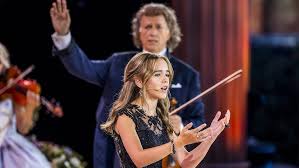
“As if heaven itself spoke” — André Rieu and a child’s voice stir a call for peace beyond music. Was this just a concert… or a divine reminder that love must triumph over pride? Audiences swore they heard not just Puccini, but the whisper of God through Amira’s angelic song. Rieu’s devotion, his tender guidance of a young guest artist, left thousands in awe and tears. Could this moment of music be a prophecy for our divided world?

There are moments in music when time seems to stand still. One such moment unfolded in Maastricht in 2014, when André Rieu, the world’s most beloved violinist, invited a young soprano named Amira Willighagen onto the stage. She was barely a teenager, yet when the first notes of Puccini’s O Mio Babbino Caro left her lips, the hall was suspended in rapture. It was as though innocence and mastery, tradition and discovery, had collided in a single, breathtaking performance.
Amira’s story already carried the markings of legend. Just a year earlier, she had astonished the world on Holland’s Got Talent with the very same aria, her voice soaring far beyond her nine years. That debut went viral, earning her international fame and the competition’s top prize. But performing alongside Rieu and his Johann Strauss Orchestra elevated her journey from talent-show sensation to something far greater: an artist stepping into history.

The aria itself has always held a special place in the classical canon. A young woman’s plea, simple yet profound, it is one of Puccini’s most enduring gifts to opera. Sung by Amira, the piece acquired an entirely new texture. Her voice, pure and unburdened, carried an emotional honesty that even the most seasoned performers sometimes struggle to achieve. Rieu’s orchestra wrapped her in sound—lush, sensitive, and perfectly attuned to the fragility of her presence. Together, they created an atmosphere of tenderness that left audiences weeping, cheering, and rising to their feet in ovation.

What made this performance unforgettable was not just the beauty of the music but the unspoken narrative it carried. Here was a child channeling centuries of operatic tradition, guided by a maestro whose career has been devoted to making classical music accessible to millions. It was a meeting of generations: one seasoned, one just beginning, and both equally devoted to the truth of the art.

Since then, Amira has continued to flourish, recording with the City of Prague Philharmonic and performing around the world. Yet many still return to that night in Maastricht, to that fragile, crystalline rendering of O Mio Babbino Caro. It remains a testament not only to her gift but also to the power of music itself—to cross ages, cultures, and languages, to remind us of what it means to feel deeply, and to remind us that sometimes, even the youngest voices can carry the oldest truths.
WATCH BELOW: