

Introduction
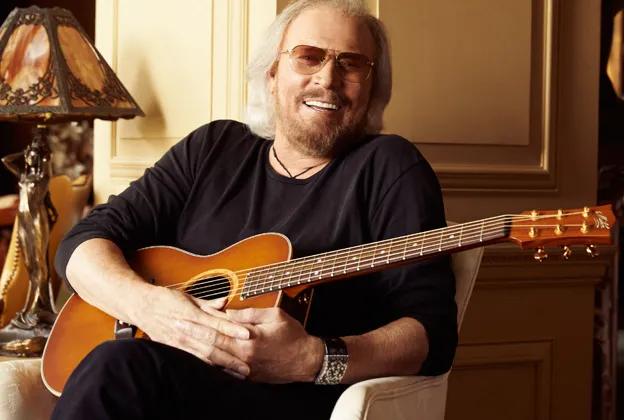
At 80 years old, Barry Gibb stands as the final heartbeat of one of the most miraculous, tragic, and history-shaping families in music. He is the last surviving Bee Gee — the architect of a sound that once made the entire planet dance, cry, and believe. But behind the knighthood, the platinum records, and the angelic falsetto that became the pulse of the 1970s, lies a man shaped not by glory… but by survival.
His story is not simply about fame. It is about fire, exile, resurrection, betrayal, brotherhood, and unbearable loss.
This is the story of a man walking alone through the ruins of a dynasty, carrying on his back the love, pain, and ghosts of three brothers who never left him.
This is the Last Harmony.
🔥 THE FLAMES THAT ALMOST ENDED HIM
Long before the white suits, long before Saturday Night Fever, long before the word “Bee Gees” meant anything to anyone, there was a tiny apartment in Manchester and a two-year-old boy on fire.
Literally.
Barry Gibb nearly died before destiny even had the chance to call his name. A childhood burn accident left him severely injured, scarred, and fighting for his life. His mother Barbara later admitted in a trembling voice:
“I didn’t think he would make it. But Barry always had this fight in him. Even then.”
That same stubborn, impossible resilience would follow the family across oceans.
In 1958, the Gibbs packed their entire lives into a few bags and escaped to Australia — broke, exhausted, but burning with hope.
It was in the dusty sunlight of Redcliffe, amid the roar of the Speedway and the chaos of working-class survival, that the brothers found harmony.
Not fame.
Not glamour.
Just harmony.
Barry — even as a child — felt the responsibility settle on his shoulders. He was the leader, the protector, the one who had to carry everyone when the world didn’t care.
And the world didn’t care.
Not yet.
🔥 WHEN THE WORLD FINALLY LISTENED
The transformation was volcanic.
With the accidental discovery of Barry’s sky-splitting falsetto — a sound so new, so electric, it shook the culture — the Bee Gees exploded into superstardom. Under the sharp, visionary management of Robert Stigwood, the Gibb brothers didn’t just ride the disco wave.
They became the wave.
In the late 1970s, Saturday Night Fever turned them into gods. “Stayin’ Alive” became an anthem. “How Deep Is Your Love” turned into a global love letter. “Night Fever” bent the decade to its will.
Barry Gibb wasn’t just successful.
He was the most successful songwriter on the planet, writing hits for Barbara Streisand, Kenny Rogers, Dolly Parton, Dionne Warwick, and countless others.
But fame always hides a knife.
Because while the Bee Gees soared higher than any trio had a right to, America turned cruel. The “Disco Sucks” movement — drenched in cultural resentment and disguised hatred — tried to burn them alive in the court of public opinion.
Barry would later describe that cultural assault with unusual vulnerability:
“It was like being inside a beautiful dream that suddenly turned into a nightmare.”
The crowds that once worshipped them suddenly wanted blood.
But Barry kept writing.
Kept creating.
Kept living.
Because he had brothers to protect — and a family legacy now too big to abandon.
💔 THE BROKEN CHORDS: WHEN THE MUSIC STOPPED
For all the fame, all the sales, all the nights in studios from Miami to Los Angeles, the real tragedy of Barry Gibb’s life is written not in chart numbers… but in funerals.
The losses came like tidal waves.
Not one.
Not two.
But three.
Andy — the golden boy with a voice made of sunlight — died at 30, lost in heartbreak and loneliness. Barry never forgave himself:
“I should have helped him more. I should have been there.”
Then came Maurice, the anchor, the joker, the problem-solver — the brother who kept the storm calm. His sudden death in 2003 shattered what was left of the Gibb foundation.
Barry was devastated… but fate was not finished.
In 2012, Robin, his twin in spirit, the other half of his artistic soul, lost his battle with cancer.
And just like that, the harmony that electrified the world vanished.
One man remained.
One voice.
One memory-keeper.
One brother.
In an interview that broke the hearts of millions, Barry confessed through tears:
“I am the last man standing.
And I would give anything to sing with my brothers again.”
He would walk into studios and hear their voices in the walls.
He would step onstage and swear he felt them beside him.
He could not escape the silence. And he did not want to.
🔥 THE GUARDIAN OF A KINGDOM
For years, Barry Gibb withdrew into grief so deep that even music — the thing that saved him his whole life — became a wound too painful to touch.
Then came the anchor who never left him:
Linda Gray Gibb, the woman who stood by him through fire, fame, fury, and funerals.
He returned to music, not for trophies, not for charts, not for the hungry music industry… but for breath.
For healing.
The album In the Now marked his emotional rebirth.
And then came the moment the world finally bowed to him.
In 2017, Prince Charles knighted him at Buckingham Palace.
Sir Barry Gibb did not kneel for himself.
He knelt for Andy, for Maurice, for Robin — for the three boys from the Isle of Man who conquered the world together.
He accepted the honor as a guardian of a miracle — the miracle of a family that turned poverty and tragedy into a sound that will live forever.
🌅 THE QUIET SUNSET
Today, in the warm stillness of Miami and Nashville, Barry Gibb lives a life of calm reflection. He is no longer haunted by the shadows of his brothers. He walks with them.
Every time a Bee Gees song floats out of a café speaker…
Every time a fan whispers “Your music saved me”…
Every time a radio DJ spins “To Love Somebody” at midnight…
The brothers are together again.
The music continues.
The love remains.
The last harmony endures.