
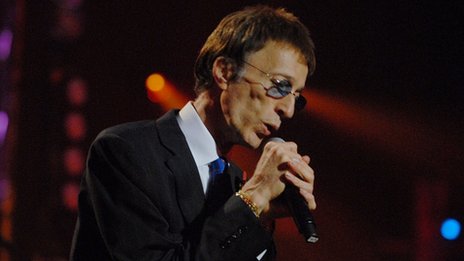
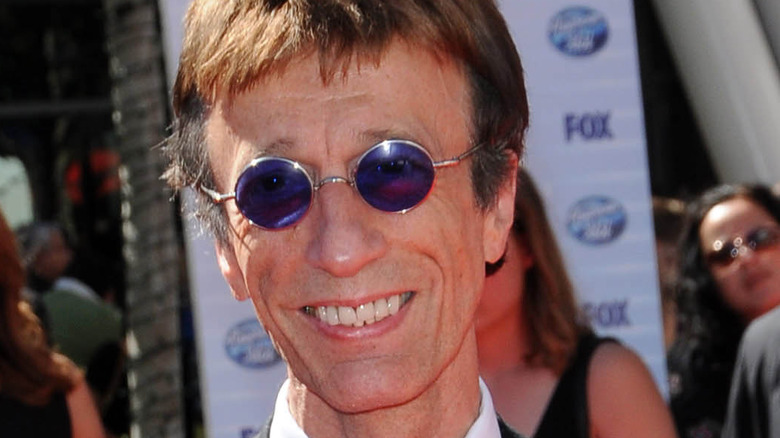
There was always something ethereal about Robin Gibb’s voice — that trembling falsetto that could slice through the pulse of disco or hover like a ghost over a ballad. As one-third of the Bee Gees, Robin helped define an era, but behind the shimmer of gold records and mirrored dance floors lay a man whose story was far deeper, sadder, and infinitely more human than the world ever knew.
Born on December 22, 1949, on the Isle of Man, Robin Hugh Gibb came into a world already humming with rhythm. Alongside his older brother Barry and his twin, Maurice, Robin grew up surrounded by music. When the Gibb family moved to Australia, the boys began performing together, forming what would become the Bee Gees — a name soon to be etched in music history.
Their early hits, like “Massachusetts” and “I’ve Gotta Get a Message to You,” showcased Robin’s distinct vibrato, filled with emotion that belied his years. But the group’s meteoric rise during the Saturday Night Fever era transformed them from pop hopefuls into international icons. With “Stayin’ Alive,” “Night Fever,” and “How Deep Is Your Love,” they didn’t just dominate the charts — they defined the sound of a generation.
Yet fame, as it often does, came at a price. Robin wrestled with creative tensions and personal demons throughout his career. Sensitive and introspective, he often felt overshadowed, even within his own band. His solo efforts, like “Saved by the Bell,” revealed a more vulnerable artist — poetic, reflective, and yearning for authenticity beyond the glitz of disco.

The Bee Gees’ legacy would eventually be marked by both triumph and tragedy. The deaths of younger brother Andy in 1988 and twin brother Maurice in 2003 left Robin devastated. “When you lose your twin, you lose yourself,” he admitted in a rare moment of candor. Still, he carried on — performing, writing, and even composing a classical work, The Titanic Requiem, a hauntingly beautiful tribute to loss and endurance.
Robin’s final years were marked by courage and grace as he battled illness with quiet determination. Though weakened, he remained creative to the end, his voice still carrying that unmistakable ache — fragile, yet filled with life. When he passed away in May 2012 at the age of 62, the music world didn’t just lose a singer; it lost one of its most emotional storytellers.
In the years since, Robin’s influence has only deepened. Artists continue to cite his songwriting, and fans still find solace in that trembling voice that could make heartbreak sound almost holy. His life — from disco glory to his silent goodbye — was a symphony of resilience, brotherhood, and boundless melody.
“Songs are forever,” Robin once said. And he was right. His music still plays — in dance halls, in heartbreaks, in the quiet hum of memory — proof that even when the lights fade, the voice of Robin Gibb will forever stay alive.